Insights · Aviation
Low-cost carriers under pressure: who will survive, and why?
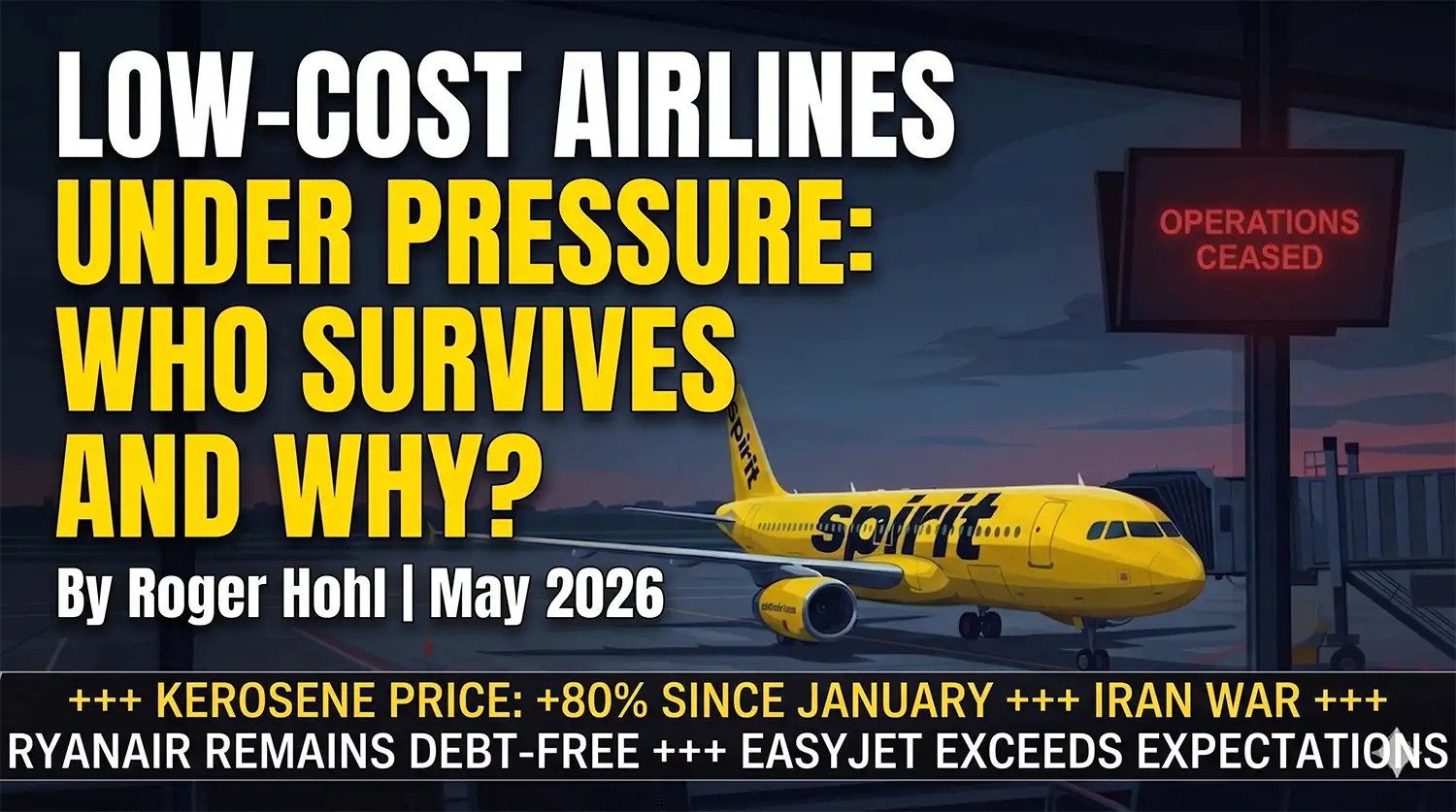
On 2 May 2026, Spirit Airlines ceased operations. Immediately, without warning to passengers. The yellow planes are grounded. Thousands of travellers are stranded, thousands of employees have lost their jobs. Negotiations for $500 million in emergency government aid failed. Bailout talks with the Trump administration yielded no results. No loans materialised, and the money ran out.
It is an ending that has been coming for a long time. Spirit had filed for bankruptcy twice since late 2024. Jet fuel prices have risen 80 percent since the start of the year, driven by the war in Iran. One structural problem compounded another until nothing could be saved.
Meanwhile, on the other side of the Atlantic: Ryanair expects to be profitable this year and is nearly debt-free. easyJet beat its 2025 profit forecasts and remains a FTSE 100 company.
Two continents, two worlds, the same business model, and outcomes that could hardly be more different. What explains this gap? And what does it tell us about the future of budget flying?
The fuel price disaster: when planning assumptions become fatal
Spirit had built its restructuring plan on an assumed jet fuel price of $2.24 per gallon for 2026. The actual price in mid-April stood at $4.32, almost double. This is not bad luck. It is the failure of a fundamental planning assumption.
Ryanair and easyJet face the same fuel prices. But they absorb the shock differently, because their cost structures, fleet sizes, and geographic diversification give them buffers that Spirit simply did not have.
This is the first great survival principle in low-cost aviation: if you are small, you must plan perfectly. Every miscalculation, every unforeseen cost increase hits small carriers with full force. Large carriers with solid balance sheets have time to react. Small ones do not.
Why Spirit really failed
The fuel price was the final blow, but not the root cause. Spirit failed for three structural reasons.
First: the niche was copied away. Spirit was the pioneer of the ultra-low-cost model in the United States, stripping away all extras, charging for carry-on bags, keeping ticket prices at rock bottom. It worked brilliantly until Delta, United, and American countered with their own basic economy fares, but with larger networks, more comfort, and free Wi-Fi. Spirit suddenly had no defensible niche left.
Second: technical problems ground down the operation. Pratt & Whitney engine defects grounded dozens of aircraft for months. Compensation payments arrived, but were not enough. An airline operating on razor-thin margins cannot survive a prolonged fleet grounding.
Third: regulatory bad luck. The planned acquisition by JetBlue, a $3.8 billion deal, was blocked by the US Department of Justice. That could have saved Spirit. Instead, the airline was left alone in a market that was structurally working against it.
Why the European model is more resilient
The European low-cost model differs structurally from the American one, and that explains much of the performance gap.
Ryanair operates in a market of short distances, high frequency, and an extremely disciplined cost model: near-uniform fleet, minimal turnaround times, secondary airports with low fees, no connecting traffic. The model is built around a single objective, cost leadership, and has not deviated from it in thirty years.
Ryanair also has a strategic strength that is often underestimated: geographic diversification across many markets. When one market weakens, others absorb the impact. Spirit had no such buffers. It flew in a single, hyper-competitive home market, and was losing to everyone at once.
Who is still under pressure in Europe
It would be too easy to declare all European low-cost carriers safe.
Wizz Air has expanded aggressively into markets with elevated geopolitical risk in recent years. Airbus delivery delays are straining its growth plan. Delay rates have drawn regulatory scrutiny. Wizz Air is not Spirit, but it is not Ryanair either.
Smaller carriers without group backing and without a clear niche are fundamentally vulnerable in an environment of rising costs and geopolitical volatility. The question is not whether more names will disappear, but when.
What this means for passengers
Spirit’s shutdown this morning left thousands of travellers stranded across the United States. JetBlue, United, Frontier, and American Airlines immediately offered emergency fares: JetBlue capped one-way prices at $99 until 6 May 2026, and Southwest at $200 on short-haul routes. A sign that the industry can act with solidarity when it must. But also a sign of what happens when a carrier collapses without a cushion.
Consumer advocates are right to warn: you do not need to fly a small carrier to benefit from its existence. Its mere presence keeps the prices of the larger carriers in check. Without Spirit, that pressure on its former routes will ease, and tickets will cost more.
In Europe, the situation has not reached this point yet. But the direction is the same: consolidation, rising prices, fewer genuine low-cost alternatives.
Conclusion: three lessons from the end of Spirit
Spirit Airlines shaped aviation for thirty years. The company invented the ultra-low-cost model in the United States, forced legacy carriers into basic economy, and made flying affordable for millions of people. That deserves recognition.
But as an aviation expert, I draw three clear lessons from its end.
First: a model built on a single cost advantage becomes vulnerable as soon as that advantage is copied.
Second: crisis plans must model genuine extreme scenarios, not optimistic averages. A fuel price of $4.32 instead of $2.24 is not an extreme scenario. It is today’s reality.
Third: survival in aviation requires buffers. Not as a luxury, but as a strategic necessity.
Ryanair has lived by these lessons for thirty years. Spirit learned them too late.
Would you like to engage Roger Hohl for an interview or analysis on the current state of the aviation industry? Get in touch now.