Insights · Tourism
Overtourism: when too many visitors destroy a destination and what the industry must learn
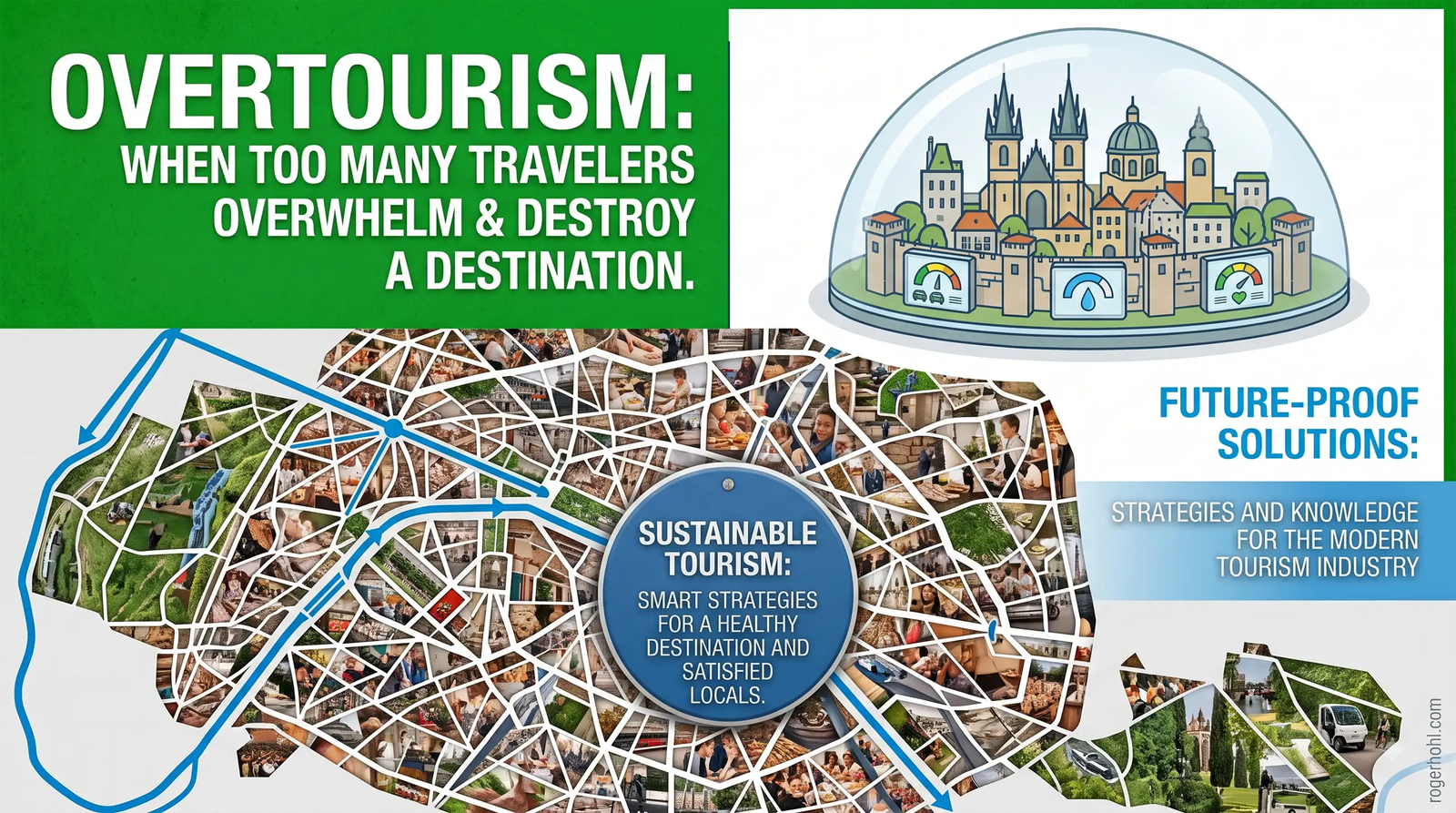
Venice has charged a day-tripper fee since 2024, and in 2026 extended it to cover more days across peak months. Barcelona is considering a full Airbnb ban until 2028. Amsterdam has banned new businesses catering exclusively to tourists: no more Segway tours, no more beer bikes. Amsterdam residents have filed a lawsuit against the city council over overtourism. Ibiza has capped rental car numbers. Norway has introduced a national tourism tax.
These are not isolated protests. This is a systemic failure. And as a tourism expert, I will say it plainly: the industry created this problem itself, through decades of growth at any cost, without investing sufficiently in capacity, visitor management, and sustainability.
Overtourism is not a natural phenomenon. It is the result of poor governance.
The scale of the problem
The numbers are striking. Portugal received around seven million tourist arrivals in 2010. By 2019, that figure had reached 25 million, more than tripling in nine years. Spain is seeing demand surge 32 percent year-on-year in 2026. Greece, Italy, and Portugal are each up roughly 20 percent.
In Europe’s ten most visited cities, tourism grew by 207 million overnight stays between 2021 and 2023. Seventy-five percent of that growth was driven by hotels and similar accommodation. In 2024 alone, 289 new hotels with nearly 39,000 rooms opened across Europe.
That sounds like growth. For the destinations bearing the load, it feels like an invasion.
Overcrowded historic centres, water shortages in summer, housing displacement for local communities, degraded natural landscapes, collapsing infrastructure. These are not mere social side effects. They are risks that make a destination unattractive in the long run. A destination that loses its character loses its guests. Slowly at first. Then quickly.
Why conventional destination management fails
Most tourism authorities measure success in arrivals and overnight stays. More is better. That was the benchmark for decades. It was the wrong one.
The problem is not volume. It is distribution. Dubrovnik understood this earlier than most: cruise ships are now deliberately spread across weekdays to smooth visitor flows into the old town. This dramatically reduces the sensation of overcrowding without reducing visitor numbers. More guests, better distributed. That is management, not restriction.
The opposite is what I observe in many destinations: no spatial management, no seasonal steering, no visitor flow guidance. Instead: more marketing in markets that are already overheated.
Destination marketing that attracts masses without building the capacity to absorb them is not a success. It is negligence.
What smart destinations do differently
There are examples showing that quality and volume are not mutually exclusive, provided you think strategically.
Venice is the best-known case. The day-tripper fee is a first step: contested, but consistent. The real objective is not revenue maximisation; it is steering. Those who pay plan their visit in advance. Spontaneous mass day trips become more expensive; multi-day hotel stays remain attractive. This shifts the balance towards higher-spending, longer visits.
Amsterdam goes further: no new tourism-oriented businesses, no Segway tours, no beer bikes. This is quality management. The city deliberately decides which tourism it wants and which it does not.
Hallstatt in Austria, widely seen as the inspiration for Arendelle in Frozen, has battled viral social media moments for years. The municipality has learned that attention cannot be switched off, but it can be managed. Timed entry, parking restrictions, targeted communication to key source markets.
These approaches share one principle: they treat tourism as a resource to be managed, not a raw material to be extracted as quickly as possible.
The consequences for hospitality operators
Overtourism is not only a destination problem. It is a concrete business risk for every hotelier and tourism operator in affected areas.
When a city loses its appeal through overload, hotels there lose their differentiation. The luxury guest who paid for the authentic Venice experience in 2010 is booking elsewhere today. Not because they no longer love the city, but because the experience they paid for no longer exists.
In my work as a tourism consultant and mystery shopper, I see this directly: hotels in overtouristed destinations increasingly struggle with quality issues that do not originate within the property itself, but in the surrounding environment. Noise, crowds, overburdened infrastructure: these drag ratings down even when the hotel itself is doing everything right.
The consequence for hoteliers is clear: passivity is not an option. Operating in an overloaded destination requires active participation in destination management: collaboration with authorities, visitor steering of their own and deliberate positioning away from the main mass-tourism flows.
What policymakers must do and where they are getting it wrong
Political measures against overtourism almost always fail for the same reason: they are deployed reactively, once the damage is already visible. A tourism tax introduced after residents take to the streets is not a strategy. It is crisis management.
What works sustainably are long-term capacity decisions: how many cruise ships may a port receive simultaneously? What land use is reserved for tourist infrastructure, and what is protected for the resident population? How are seasonal peaks actively managed?
These questions need answers before a destination reaches the tipping point, not after. Tourism is one of the most important sources of income for many European regions. Threatening it by allowing it to grow unchecked is short-sighted.
Conclusion: quality, not growth, is the goal
The most profitable destinations in the world are not those with the most visitors. They are those with the most satisfied visitors and the most viable communities.
Overtourism is solvable. But only if destinations, hoteliers, operators, and policymakers stop treating growth as an end in itself. The benchmark must shift: from arrivals to value creation, from volume to quality, from short-term occupancy to long-term attractiveness.
As a tourism expert, I help destinations and operators make this shift strategically. Because one thing is certain: the destinations that manage wisely today will still exist in twenty years. The others will not.
Would you like to engage Roger Hohl for a consulting mandate, advisory board role, or media interview on overtourism? Get in touch now.